
When a drawing is sent out for quotation, the phrase CNC milling services can cover very different levels of capability. One supplier may specialize in straightforward plates and brackets. Another may be set up for multi-face parts, complex fixtures, detailed inspection, and repeat production.
Understanding those differences helps buyers ask better questions, compare quotations on the same basis, and choose a supplier whose equipment and process controls match the part.
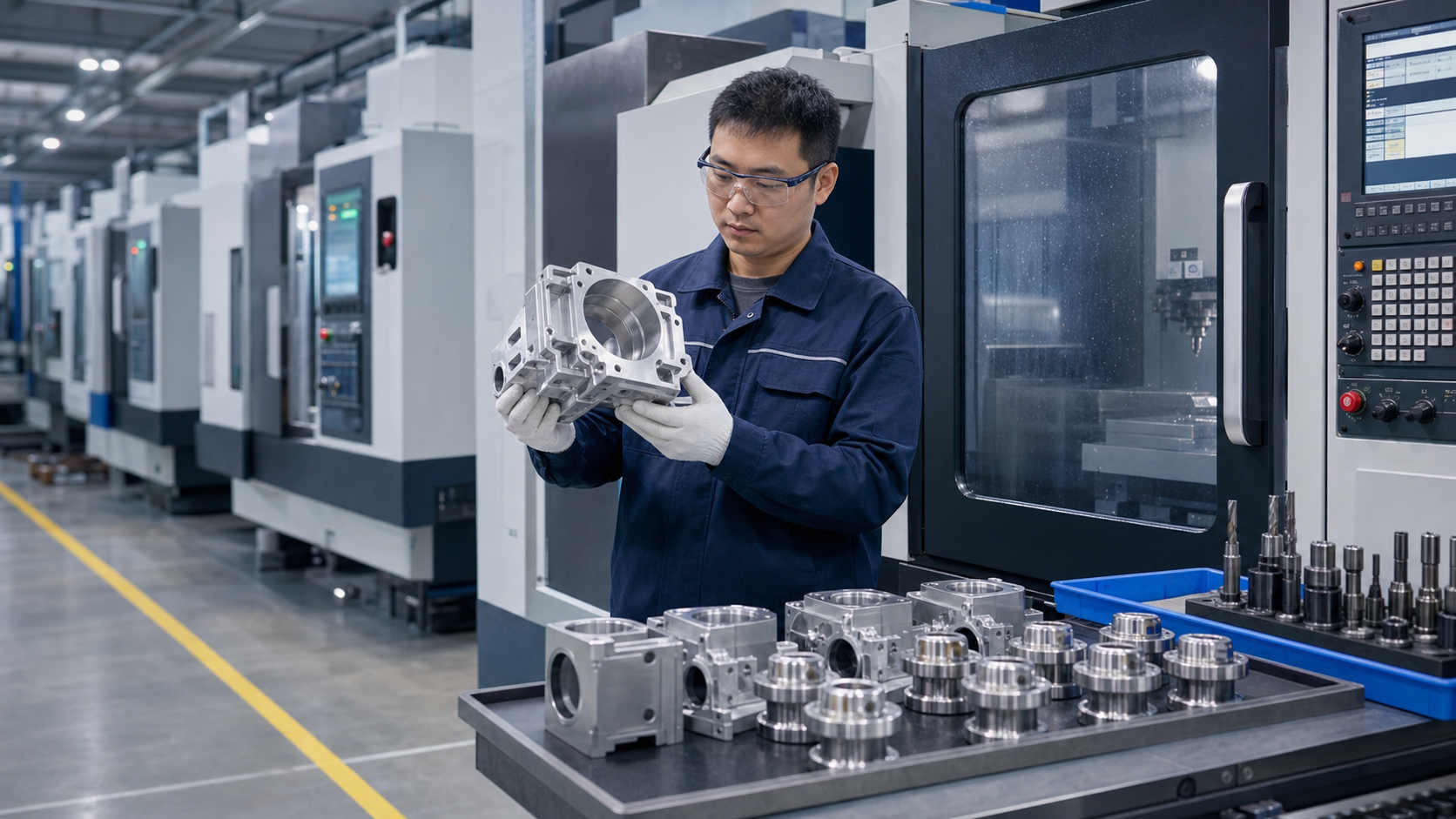
CNC milling capability depends on more than the machine itself; programming, fixturing, tooling, inspection, and production control all affect the result.
CNC milling is a subtractive manufacturing process. A rotating cutting tool removes material from a workpiece that is held in a fixture or workholding system. The machine moves the tool, the workpiece, or both along programmed axes to create the required geometry.
This differs from CNC turning, where the workpiece normally rotates while a cutting tool shapes it. Milling is commonly used for:
The program determines the toolpath, but repeatable production also depends on stable workholding, suitable cutting tools, controlled tool wear, material consistency, and an inspection plan that reflects the drawing.
The correct machine configuration depends on the geometry, tolerance relationships, surface requirements, quantity, and cost target. More axes do not automatically produce a better part; they provide additional ways to reach features and reduce setups.
A 3-axis machining center moves along the X, Y, and Z linear axes. It is well suited to plates, brackets, housings, heat sinks, fixtures, and other mainly prismatic parts.
Features on different sides may require the part to be repositioned. With well-designed fixtures and a controlled setup process, 3-axis milling can still produce accurate precision components economically.
A 4-axis machine adds a rotary axis. The workpiece can be indexed to present several faces to the cutting tool, and some machines support continuous rotary motion.
This configuration is useful for parts with repeated features around a diameter, multi-side machining, curved profiles, and situations where reducing manual repositioning improves consistency.
Five-axis machining allows the tool to approach the workpiece from multiple directions. Depending on the machine and program, the additional axes may operate simultaneously or position the part between cutting operations.
It is often selected for:
Five-axis machining can reduce the number of setups and improve positional relationships between features. It does not make every undercut directly machinable; tool access, holder clearance, part geometry, and workholding still need to be reviewed.
The most economical machine is the one that can reach the required features while maintaining the drawing relationships with a practical number of setups.
For repeat orders, the production method matters as much as the axis count. Dedicated fixtures, standardized tools, probing, pallet systems, tool-life controls, and optimized programs can reduce cycle time and variation.
BIE supports prototype and production orders, with quantity reviewed according to part geometry, material, fixture requirements, inspection, and finishing. Typical lead time is about 7 days for prototypes and about 30 days for production, subject to project requirements.
Material choice affects cutting conditions, tool life, achievable detail, dimensional stability, surface appearance, and cost.
6061-T6 is widely used for housings, brackets, fixtures, and general structural parts because it combines machinability, corrosion resistance, and good anodizing response. 7075 is selected when higher strength is needed, although cost, corrosion behavior, and finishing appearance differ from 6061.
Grades such as 304, 316, and 17-4 PH are used where corrosion resistance, strength, or cleanliness matters. Stainless steel generally requires more conservative cutting conditions and careful control of heat, work hardening, and tool wear.
Food, medical, and regulated applications require more than a material name. The drawing and purchase order should define the applicable grade, condition, traceability, finishing, cleanliness, and documentation requirements.
These materials are common in machinery, fixtures, molds, wear components, and structural applications. Hardness and heat-treatment condition strongly influence machining strategy. Some parts are rough machined before heat treatment and finish machined afterward to control distortion and final dimensions.
Free-machining brass can produce clean features and is widely used for fittings, electrical parts, and connector components. Copper alloys vary considerably in machinability. High-conductivity copper can be more difficult to control because it is ductile and transfers heat efficiently.
POM, nylon, PEEK, PTFE, ABS, and other plastics can be milled into insulators, guides, lightweight housings, and fluid-handling components. Plastic parts require attention to heat, clamping pressure, moisture absorption, burrs, and dimensional change.
Titanium is valued for strength-to-weight ratio, corrosion resistance, and biocompatibility in suitable grades. Its low thermal conductivity and tendency to react with cutting tools make heat management, tool engagement, and process stability especially important.
CNC milling supports product development, tooling, replacement parts, and serial production across many industries.
Typical parts include structural brackets, housings, manifolds, fixtures, and test equipment. Projects may require material traceability, controlled special processes, detailed inspection, and customer-specific quality requirements. These requirements should be defined in the RFQ and reviewed before quotation.
Applications include prototype housings, powertrain and suspension components, battery-system parts, fixtures, and production tooling. Buyers should define the required material, inspection, traceability, documentation, and testing requirements for each project.
Milled parts appear in laboratory instruments, diagnostic equipment, device housings, and non-implant mechanical components. Buyers should clearly define material, cleanliness, traceability, inspection, and documentation requirements for the intended application.
Common components include aluminum enclosures, heat sinks, RF housings, test fixtures, connector parts, vacuum-equipment components, and precision motion-system parts. Cosmetic zones, flatness, cleanliness, thermal contact, and anodizing consistency are frequent concerns.
OEM and MRO applications include custom plates, housings, manifolds, tooling, jigs, replacement parts, and machine assemblies. Reverse-engineering work should define which dimensions are functional and how worn reference parts will be interpreted.
Valve parts, manifolds, sealing components, and equipment housings may use stainless steel, alloy steel, nickel alloys, or other corrosion-resistant materials. Pressure boundaries, material traceability, NDT, and industry specifications should be identified during the RFQ.
Price matters, but a useful supplier comparison also examines process ownership, engineering response, inspection, capacity, and delivery control.
Ask for an equipment list and the usable work envelope of relevant machines. Confirm whether complex features require 4-axis or 5-axis positioning and which operations will be subcontracted.
BIE operates 70+ machines in an over 3,000 m² facility in Fenggang, Dongguan, supporting custom precision parts from prototypes to production. Buyers should still connect the available equipment to the proposed process, work envelope, axis configuration, fixtures, inspection resources, and current capacity.
Avoid evaluating a supplier through one advertised tolerance number. Achievable tolerance depends on feature size, material, geometry, wall thickness, datum structure, fixture stability, temperature, batch size, and measurement uncertainty.
A credible review should answer:
BIE is certified to ISO 9001, ISO 14001, and ISO 45001. Buyers should still confirm the certificate scope and define the required inspection level, sampling plan, material traceability, and documentation package for each order.
If a project has restricted-substance requirements such as RoHS, identify the applicable material and documentation expectations in the RFQ.
Ask about realistic scheduling for the required material, quantity, and secondary processes. A lead time should be treated as project-specific until the drawing and supply chain have been reviewed.
Useful DFM feedback should explain the cost or quality consequence of a design choice. Examples include:
The designer remains responsible for functional requirements. The supplier's role is to identify manufacturing risk and propose options before production.
Common finishing options include:
BIE coordinates anodizing, plating, electroless nickel, powder coating, and other secondary processes through controlled finishing partners. The finish specification, masking, cosmetic standard, dimensional allowance, and inspection method should be agreed during quotation.
A complete RFQ helps the supplier quote the intended part rather than a collection of assumptions. Include:
State which document governs if the model and drawing conflict. For overseas sourcing, also define Incoterms, required export packaging, and whether original material test reports are needed.
BIE provides custom CNC milling for aluminum, steel, stainless steel, brass, copper alloys, titanium, and engineering plastics. Send the 3D model, controlled drawing, material, quantity, finishing, inspection, and documentation requirements so the team can review manufacturability and prepare a project-specific quotation.
BIE reviews order quantity according to the part and production process. Typical lead times are about 7 days for prototypes and 30 days for production, depending on project requirements.
Copyright © Dongguan BIE Hardware Co., Ltd - Privacy policy
