
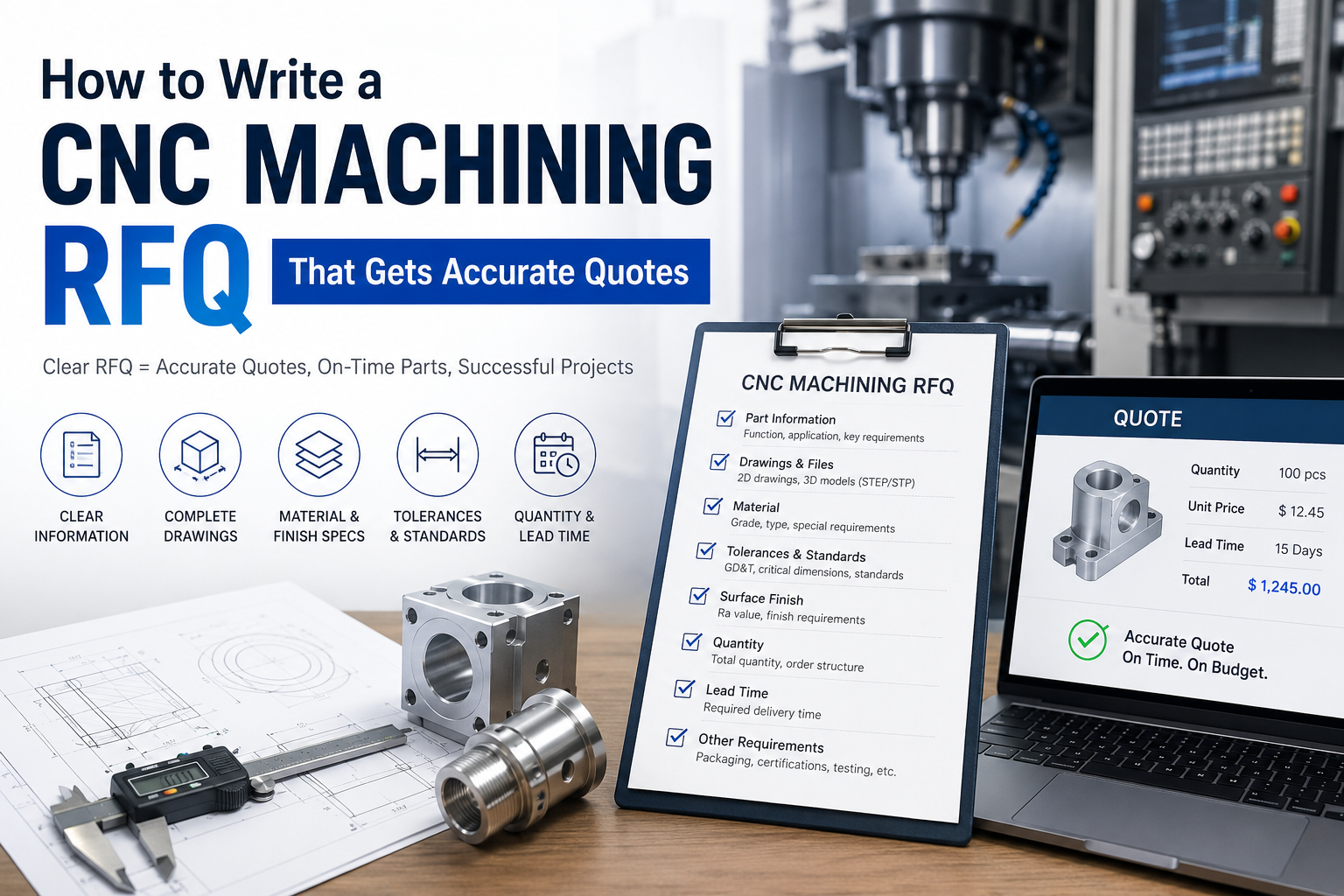
A Request for Quotation (RFQ) is the starting point of every CNC machining order. The quality of the quote you receive is directly proportional to the quality of the information you provide. An incomplete RFQ leads to assumptions — and assumptions lead to quotes that don't reflect reality, surprises after the order is placed, and delivery or quality problems that were entirely preventable.
This guide covers exactly what to include in a CNC machining RFQ, why each element matters, and the mistakes that experienced procurement engineers learn to avoid.
|
✓ |
RFQ Element |
Why It Matters |
|
□ |
2D drawing with title block |
Defines part number, revision, drawing units, and general tolerance. Without it, the supplier is guessing at defaults. |
|
□ |
3D model (STEP or IGES) |
Allows accurate CAM programming and DFM review. Reduces interpretation errors vs. 2D alone. |
|
□ |
Material specification (grade, not just type) |
"Stainless steel" is not enough — specify 316L, 17-4PH, etc. Wrong grade = wrong properties and potential compliance failure. |
|
□ |
Critical dimensions flagged |
Mark which tolerances are functionally critical vs. general reference. Helps supplier prioritize inspection and flag concerns. |
|
□ |
Surface finish requirements |
Ra value and location. If no callout, supplier defaults to general machined finish which may not suit your application. |
|
□ |
Quantity (prototype vs. production) |
Quantity drives pricing, lead time, and process decisions. Include future volume expectations if relevant. |
|
□ |
Required delivery date |
Realistic timeline enables honest scheduling. Impossible deadlines produce rushed parts or broken promises. |
|
□ |
Special requirements |
Heat treatment, certifications (material certs, FAI, RoHS), packaging, marking, or customer-specific quality requirements. |
No element of your RFQ matters more than the drawing. A complete, unambiguous engineering drawing eliminates interpretation and gives the supplier everything they need to produce a precise quote and manufacture conforming parts.
For CNC machining, the ideal submission is a 2D drawing with full dimensioning and tolerancing combined with a 3D STEP or IGES model. The 2D drawing defines requirements — tolerances, surface finish, material, special callouts. The 3D model enables accurate CAM programming and DFM review. When the two conflict, the 2D drawing governs unless you specify otherwise.
If you're submitting a 3D model only — common in early development — make sure your model is fully featured with all critical dimensions accessible, and note in your RFQ which dimensions are critical and what tolerances apply to them.
"Aluminum" is not a material specification. Neither is "stainless steel" or "plastic." Each of these categories includes dozens of alloys and grades with significantly different properties, machinability, cost, and availability. A supplier who receives an underspecified material callout will either ask for clarification (delaying the quote) or make an assumption (creating a risk).
Always specify the exact grade: 6061-T6 aluminum, 316L stainless steel, Ti-6Al-4V Grade 5, PEEK unfilled. If you have flexibility — if 6061 or 6082 would both work — say so explicitly. That flexibility can sometimes save cost or lead time if one grade is more readily available than the other.
If your application has regulatory material requirements — RoHS compliance, FDA food contact, biocompatibility — include those in the RFQ. They affect both material selection and the documentation required at shipment.
Quote the quantity you need now, but also share your anticipated future volumes if you have them. A supplier pricing a 10-piece prototype order with no context will optimize setup and tooling for flexibility. A supplier who knows that 10 pieces now will become 500 pieces per quarter in six months may invest in more efficient fixturing that benefits you on the production pricing.
If you need both a prototype quantity and a production quantity quoted simultaneously, say so. Many buyers get prototype and production prices in the same RFQ round so they can make informed decisions about design changes before committing to production tooling.
"As soon as possible" is not a useful timeline. It tells the supplier nothing about your actual schedule requirements and invites them to promise something they may not be able to deliver. A specific required delivery date — combined with your understanding that there may be a premium for expediting — gives the supplier actionable information.
If your timeline is flexible, say that too. A supplier with a busy queue may be able to offer a lower price on a relaxed schedule. Conversely, if your timeline is non-negotiable, communicating that clearly upfront prevents a scenario where parts arrive a week late because the supplier didn't understand the urgency.
Any requirement that isn't on the drawing needs to be in the RFQ. This includes certificates of conformance, material certifications with specific traceability requirements, first article inspection reports, specific packaging requirements (ESD bags, individual part bags, custom labeling), country of origin documentation for import purposes, and any customer-specific quality clauses.
Suppliers who receive these requirements after the order is placed may not be able to accommodate them, or may charge a premium for documentation they didn't plan for. Surprises late in the procurement process are expensive for everyone. An RFQ that captures all requirements upfront eliminates them.
A good RFQ deserves a timely, detailed quote in return — typically within 24–48 hours for standard parts. When you receive a quote, review it against your checklist: does the material match your specification exactly? Is the quantity correct? Does the lead time definition match your understanding? Are there any exclusions or assumptions noted?
If the quote includes assumptions or deviations from your RFQ, clarify them before placing the order. A five-minute conversation at the quote stage prevents a much longer conversation after parts are rejected at incoming inspection.
Copyright © Dongguan BIE Hardware Co., Ltd - Privacy policy
