
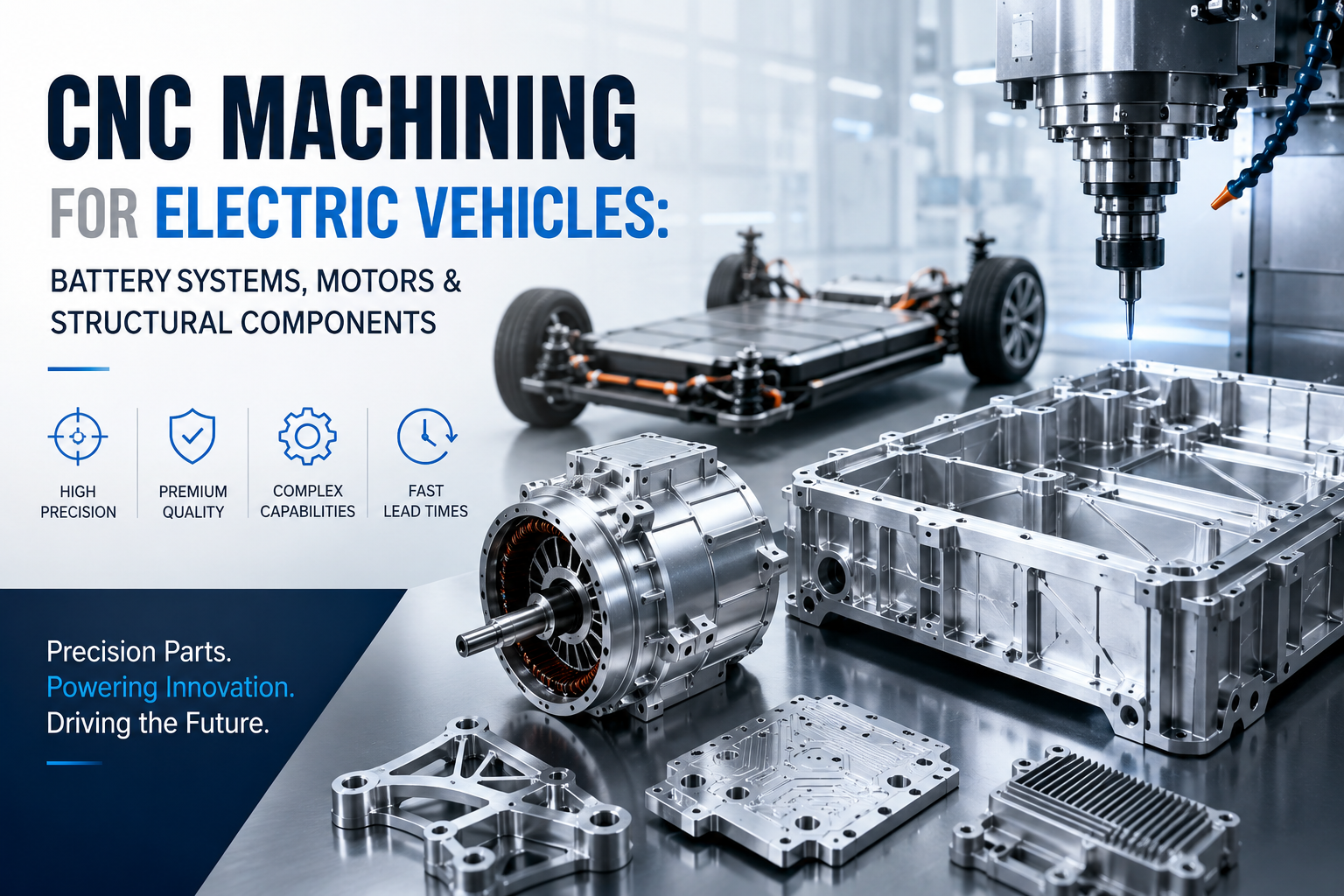
Electric vehicles are reshaping the automotive manufacturing landscape — and CNC machining sits at the center of that transformation. Unlike internal combustion powertrains, where many components are cast and finished, EV systems demand precision-machined parts across nearly every subsystem: battery enclosures, motor housings, power electronics, thermal management, and structural components all rely on CNC machining to meet the dimensional accuracy, surface quality, and material performance requirements that EV platforms demand.
This article covers the full scope of CNC machined parts in electric vehicles — what they are, what materials they use, what tolerances they require, and what separates a capable EV machining supplier from one that will slow your program down.
|
EV System |
Key Machined Components |
Primary Materials |
Critical Requirements |
|
Battery System |
Enclosure housings, cooling plates, bus bars, module end plates |
6061/6082 Al, C10100 copper |
Flatness, IP sealing, thermal conductivity |
|
Electric Motor |
Motor housings, rotor shafts, stator cores, end bells |
6061 Al, 4140 steel, copper |
Bore concentricity, tight fits, balance |
|
Power Electronics |
Inverter housings, heat sinks, bus bar brackets |
6061 Al, C11000 copper |
Flatness, thermal interface, EMI shielding |
|
Drivetrain |
Gearbox housings, differential cases, output shafts |
4140/4340 steel, 7075 Al |
Gear bore accuracy, surface finish |
|
Chassis & Structure |
Battery tray, subframe brackets, crash structures |
6061/6082 Al, UHSS |
Dimensional accuracy, weld prep surfaces |
|
Thermal Management |
Coolant manifolds, chiller plates, pump housings |
6061 Al, 316 SS |
Internal channel integrity, leak testing |
The battery pack enclosure is one of the most dimensionally demanding machined assemblies in an electric vehicle. It must seal reliably against water and dust ingress (typically IP67 or IP68), provide a flat, consistent sealing surface for gasket or adhesive interfaces, accommodate dozens of precision-located mounting points for modules, busbars, and BMS hardware, and survive crash loads without catastrophic deformation.
Most EV battery enclosures are machined from 6061-T6 or 6082-T6 aluminum — both offer the combination of low density, good machinability, adequate strength, and excellent corrosion resistance needed for a structural enclosure that sees thermal cycling and road vibration throughout its service life. Flatness on sealing surfaces is typically held to 0.1–0.2mm across the full sealing perimeter. Mounting hole positions are held to ±0.1mm or tighter to ensure module alignment.
Thermal management is one of the defining engineering challenges in EV battery systems. Cooling plates — machined aluminum plates with internal fluid channels pressed or bonded against battery module surfaces — are a critical component of most liquid-cooled battery architectures. The machining requirements are demanding: internal channel geometry must be accurate to ensure consistent flow distribution, surface flatness must be tight enough to maintain good thermal contact with module surfaces, and port locations must align precisely with manifold connections.
Cooling plates are typically machined from 6061 or 6082 aluminum, with internal channels produced by milling before a cover plate is friction-stir welded or brazed in place. Leak testing is performed on every assembly — even a small porosity or machining defect in the channel wall creates a field reliability problem.
High-current electrical connections within battery packs use machined copper busbars — precisely dimensioned conductors that distribute current between cells, modules, and external connections. Copper C10100 (oxygen-free) and C11000 (electrolytic tough pitch) are the standard grades, selected for maximum electrical conductivity. Machined features include precision hole patterns for bolt connections, profiled cross-sections for current capacity optimization, and smooth surfaces to minimize contact resistance at interfaces.
The electric motor housing performs multiple critical functions simultaneously: it provides the structural frame for stator retention, houses the bearing seats that support the rotor shaft, seals the motor against the environment, and often integrates the cooling jacket for liquid thermal management. Each of these functions places distinct machining requirements on the housing.
Stator bore diameter and cylindricity are among the most critical dimensions in the entire powertrain — stator-to-housing interference fit must be controlled to prevent relative movement under thermal cycling while maintaining electrical isolation. Bearing seat bores require tight diameter tolerances (typically H7 or tighter) and geometric controls on cylindricity and perpendicularity to the shaft centerline. Coolant jacket channels require the same integrity requirements as battery cooling plates — accurate geometry and leak-free construction.
Motor housings are almost universally machined from 6061-T6 aluminum for passenger vehicle applications, offering the thermal conductivity, machinability, and weight efficiency the application demands.
The rotor shaft transmits torque from the motor to the drivetrain while supporting the rotor stack and spinning at speeds that can exceed 15,000–20,000 RPM in high-performance EV applications. The machining requirements reflect these demands: journal diameters for bearing fits are held to tight cylindricity and diameter tolerances; runout across the full shaft length is controlled to minimize vibration at high speed; spline or keyway features for rotor and output coupling engagement require accurate profile geometry; and surface finish on bearing journals is typically Ra 0.4–0.8μm.
Rotor shafts are typically machined from 4140 alloy steel, heat-treated to achieve the combination of surface hardness and core toughness needed for fatigue resistance under torsional and bending loads. High-performance applications may use 4340 for increased strength capability.
Inverters, DC-DC converters, and onboard chargers are the power electronics subsystems that manage energy flow in an EV. Their housings and thermal management components require CNC machining for EMI shielding effectiveness, thermal interface quality, and connector alignment accuracy.
Inverter housings are typically machined aluminum enclosures with tight flatness requirements on sealing surfaces and precise hole patterns for power connector interfaces. Heat sinks — either extruded and machined or fully machined from billet — require controlled fin geometry for thermal performance and flat base surfaces for thermal interface material contact. Copper bus bars inside the inverter carry hundreds of amps and require the same precision machining as battery pack busbars.
A recurring requirement across power electronics enclosures is EMI shielding integrity — any gap, misaligned surface, or poor-fitting cover compromises shielding effectiveness. Machining tolerances on mating surfaces and cover fits are typically tighter than in other automotive enclosure applications for this reason.
Unlike internal combustion vehicles with multi-speed transmissions, most EVs use single-speed reduction gearboxes that step down motor speed to wheel speed. These housings are structurally demanding — they carry gear loads, provide precision bearing supports, and must maintain gear mesh geometry over thermal cycles and load variations.
Gear bore diameters and their positional relationship to each other (center distance) are the critical machined dimensions — errors here translate directly into gear noise, efficiency loss, and durability reduction. Bearing bores are held to H6 or tighter fits. Center distance is typically controlled to ±0.025mm or better. Housing materials range from 6061 aluminum for passenger vehicle applications to 4140 steel for heavy-duty and performance applications.
Output shafts, halfshafts, and constant velocity joint components translate drivetrain torque to the wheels while accommodating suspension travel. These components are machined from alloy steel (typically 4140 or 4340), heat-treated, and ground on critical journal and spline surfaces. EV applications place these components under higher sustained torque than equivalent ICE vehicles — immediate motor torque delivery means no torque ramp-up, and regenerative braking adds reverse torque cycles that ICE drivetrains don't experience in the same way.
Battery tray structures — the primary structural element that houses the battery pack and integrates with the vehicle floor — are often machined aluminum extrusion or casting assemblies with machined interfaces. Precise flatness and hole pattern accuracy on battery tray mounting surfaces ensure proper battery pack sealing and structural integration. Subframe and suspension mounting brackets require tight geometric tolerances on mounting interfaces to maintain suspension geometry and NVH performance.
Crash management structures — designed to absorb impact energy in a controlled sequence — require machined trigger features and precise wall thicknesses to ensure predictable deformation behavior. These features are machined to tight tolerances because their geometry directly determines the crash performance the structure was engineered to deliver.
EV development programs move fast. Design iterations happen on compressed timelines, and prototype parts need to be in engineers' hands in days, not weeks. A machining supplier who can turn around prototype parts quickly — while still maintaining the dimensional accuracy needed for meaningful validation testing — is a genuine competitive advantage in an EV development program.
EV programs start with handfuls of prototype parts and scale to thousands of production units. A supplier who can support both phases — quick-turn prototypes with full documentation and volume production with consistent quality and controlled lead times — eliminates the costly and risky supplier transition that often happens when development shops can't handle production volumes.
EV component designs are often pushing the edges of what's been done before — new geometries, new material combinations, aggressive weight targets, and packaging constraints that make manufacturing difficult. A machining partner who engages engineering review early — flagging DFM concerns, suggesting alternative approaches, and contributing manufacturing knowledge to the design process — helps EV teams arrive at designs that are both functionally excellent and manufacturable at cost.
EV manufacturers — particularly those supplying to OEMs or operating in regulated markets — require material traceability, dimensional inspection documentation, and quality system compliance from their machining suppliers. Mill certifications, CMM reports, and certificates of conformance are baseline expectations, not special requests.
Copyright © Dongguan BIE Hardware Co., Ltd - Privacy policy
